

Thinking · October 2026 · Position
The chatbot paradox
Conversational AI is worth most where the customer cannot choose alone, and very little where they can. Its value scales with the size of the assortment problem.
Start with the least exciting number in UK ecommerce. Across 168 UK retailers in IMRG’s 2026 benchmark, AI assistants delivered 0.39% of site traffic. On a base of 120 of those retailers, that traffic converted at 2.28%. In IMRG’s channel table it sits at 2.3% against 2.2% for organic search, thirteenth of eighteen channels. That is IMRG’s number, not a vendor’s, and it describes a channel that is small and, on average, ordinary.
of site traffic from AI assistants, 168 UK retailers
conversion on that traffic, 120 retailers
of eighteen channels in IMRG’s table
The same deck carries a second finding that appears to contradict the first. When IMRG asked retailers where AI had delivered the best return so far, chatbots and virtual assistants were the fastest-rising answer, up 25 points in six months. Small and ordinary on average, rising fast where it works. Both are true, and the useful question is where it works.
What the best evidence says
The strongest independent study so far is Kaiser and Schulze, now peer reviewed in Marketing Science (July 2026). They examined 973 websites across 24 categories over twelve months, comparing around 50,000 ChatGPT-referred transactions against 164 million from traditional channels. Overall, ChatGPT referrals were under 0.2% of visits and converted below most established channels. But in high-complexity categories, sites received 4.6 times the share of ChatGPT referral traffic, and there that traffic out-converted five of the eight traditional channels it was measured against.
Two cautions, because this page does not stretch evidence it did not earn. The authors describe the complexity finding as exploratory. And their complexity is a property of the category (vehicles, finance, business services), not of the breadth of a retailer’s range. Carrying their result across to retail assortments is the practice’s inference, and it is marked as such here.
The inference is this. The thing that makes a category complex for a shopper is the number of plausible options multiplied by the difficulty of telling them apart. A retailer can create that condition inside any category. Call it the assortment problem: the share of the range where a customer cannot reach a confident decision without help.
The top end of the paradox
The business with the largest assortment problem in retail built the largest assistant. Amazon told investors in February 2026 that Rufus had served more than 300 million customers and delivered nearly $12 billion in incremental annualised sales in 2025. That is Amazon’s own estimate on a method it has not published, so treat it as a disclosure, not a measurement. In May 2026 Amazon folded Rufus into Alexa for Shopping and gave it more to do, including buying on third-party sites. Infinite catalogue, real discovery problem, a guide that earns its keep.
The bottom end, tested
In July 2026 THG Ingenuity announced that MP Activewear shoppers who generated at least one image with its AI Stylist were nearly six times more likely to convert than the site average, with a 2.5% higher average order value.
I tried it, with a photograph of a family member standing by a river in a navy tee. The tool returned the same scene, same river, same stance, with a grey £5.99 MP tee in place of the navy one. It asked nothing about height, chest size, or how the wearer likes a tee to fit. It proposed nothing to wear with it. It is a garment-swap render with a stylist’s name.
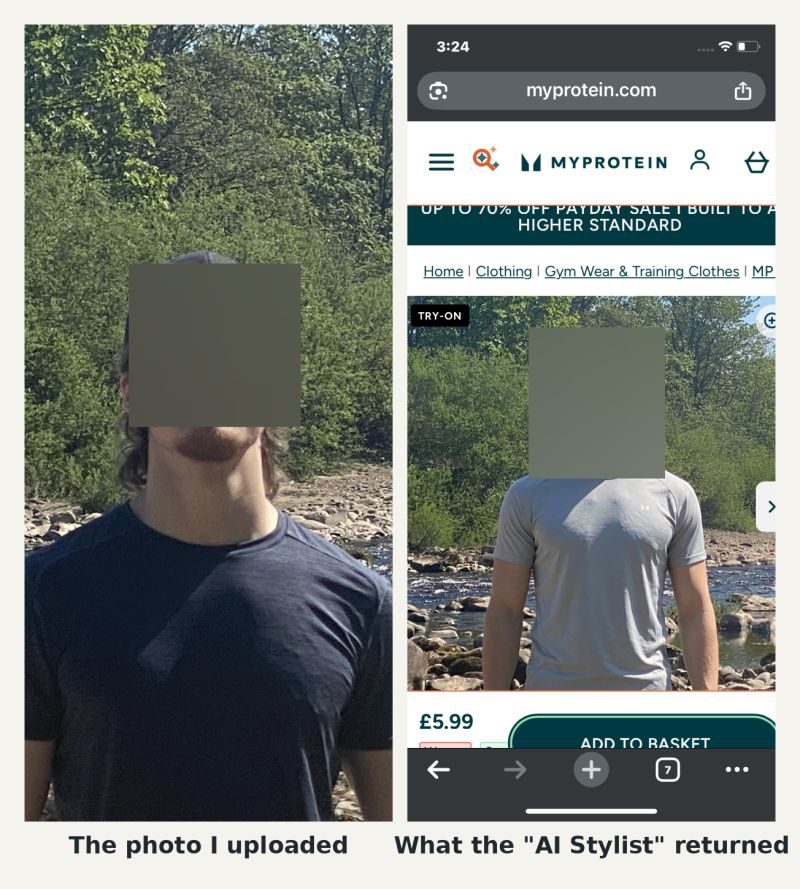
Left: the photograph uploaded. Right: what the MP Activewear AI Stylist returned, July 2026. Face obscured by Barking Cat.
Virtual try-on has its uses, and garment visualisation is one of them. What the test shows is the paradox at the bottom end. A single-brand activewear range is about as small an assortment problem as retail offers, so there was nothing for a stylist to do, and the tool did not attempt it. The question the customer actually needed answering was whether the medium would fit, and that question went untouched. In a vendor-sponsored study of the UK’s top 100 fashion retailers, size and fit drove 52.9% of returns between September and December 2025; directional, given who paid for it, but consistent with every returns ledger I have read.
The same test anchors the written version of the eCommerce Expo session on customer signals.
The six-times figure has the shape of a behavioural signal and the substance of a selection effect. Shoppers who choose to upload a photograph are the most committed shoppers on the site before the tool does anything. With no control group, the figure tells you who used the feature, not what the feature did. THG Ingenuity sells the AI Stylist on Google Cloud Marketplace, which is worth knowing before anyone repeats the number.

What this means for a retailer
One number decides how much a chatbot can ever do for you: the share of your range that involves a decision a customer cannot make alone. Your AI budget has no bearing on it.
From this piece
Your AI budget has no bearing on it.
If that share is large (technical products, compatibility questions, wide ranges of near-substitutes, anything sized), a conversational layer can do real work, and the work starts with product data good enough for it to reason over. If the share is small, because the proposition is curation, a chatbot on the site is a chat window in front of a search box. The money is better spent on the size guide, the product data and the photography, which also happen to be what an assistant elsewhere reads when it decides whether to recommend you.
The paradox cuts the other way too. A curated brand does not escape conversational AI by declining to build it, because the customer’s assistant has a view on the brand whether the brand participates or not. What it does escape is the cost of building something its customers have no use for.
Sources
- IMRG, Tech and AI Connect: Innovation, Insight and the Next Era of AI in Retail, July 2026: AI assistant share of traffic (168 retailers, p.24); channel conversion table (p.25); AI assistant conversion (120 retailers, p.26); best-ROI question (p.7). Measurement period not stated on the slides.
- Kaiser, M. and Schulze, C., ChatGPT Referrals to E-Commerce Websites: How Do LLMs Compare Against Traditional Channels?, Marketing Science 45(4), July 2026; working paper SSRN 5585812. Data supplied by Grips Intelligence, with which the lead author is affiliated.
- Amazon.com, Fourth Quarter 2025 results release, February 2026; Q3 2025 earnings call, 30 October 2025. Company estimate, method unpublished.
- Amazon, Alexa for Shopping announcement, 13 May 2026.
- THG Ingenuity, AI Stylist press release, 29 July 2026 (vendor: sells the product measured); TheIndustry.fashion, 31 July 2026.
- Barking Cat, first-hand test of the MP Activewear AI Stylist, July 2026.
- Return Economics 2026, UK top 100 retailers, p.4 (vendor-sponsored by Ingrid, Harper and Limesharp; directional).