

Thinking · November 2026 · Position
What most retailers need instead of a shopping agent
On 21 October AWS called Therabody’s new shopping assistant “another proof point that retailers, not general AI platforms, should own the customer relationship”. McKinsey’s survey of about 21,000 consumers suggests that relationship is starting to move: 29% of AI shoppers said an AI chat or search tool had the biggest influence on their last purchase.
The worry behind AWS’s line is real. In the McKinsey survey, published on 28 October, AI chat and search tools out-influenced traditional search engines (9%), and retailers’ own platforms and AI assistants combined (21%). AWS has been selling retailers the technology behind Amazon’s own assistant since May, so its answer is predictable: build your own.
Amazon is also marking its own homework. Its advertising business took $68.6 billion in 2025, with sponsored listings the largest part, and that business depends on shoppers being on Amazon. Amazon has sued Perplexity over its shopping agent, blocked Meta’s Muse agent from its store on 20 September, and its UK robots.txt file asks 99 named bots, including those used by ChatGPT, Claude, Perplexity and Google’s shopping agent, not to crawl any of its pages. Telling other retailers to keep their customers on their own sites is consistent with that position.
For most retailers below Amazon’s scale, the practice’s answer is different. Do not make a shopping agent the first investment. Make sure other people’s agents can find you, and that your own site can close the sale when they send the shopper there.
That puts four pieces of work ahead of any agent: being findable in AI answers, product information an agent can trust, a site that converts the shopper an agent sends, and a checkout an outside agent can use. Building comes fifth, and only where the customer’s choice is harder than merchandising can answer.
Two different things are called agentic commerce
Inside a monolith, agentic commerce is assisted shopping on the site. Amazon has millions of products, and an assistant that helps a customer through them is proportionate to the problem. Amazon told investors in February that more than 300 million customers used Rufus in 2025; that is its own figure, on a method it has not published. The practice’s reading is that Amazon works well for a shopper who knows what they want, and badly for one who arrives looking for inspiration or help.
Off the site, agentic commerce is research. A shopper describes a need, and a general AI tool works out which product meets it. That step may not be the last thing the shopper does before visiting a site, but it is where the shortlist gets made.
A retailer with 1,400 or 10,000 products is in the second situation, and an assistant on its own site does nothing about it.
What eight agents did with the same two briefs
On 10 November Barking Cat gave the same two briefs to eight agents: five general assistants (ChatGPT, Gemini, Perplexity, Google’s AI Mode and Claude) and three built by retailers (Amazon’s Rufus, Ask Frasers and the ASOS Stylist inside ChatGPT). The hard brief was an outfit for a November wedding in the Cotswolds, for a man in his forties, 42 chest, 34 waist, navy and earthy colours, about £300. The easy brief was white Nike Air Force 1 ’07 trainers in UK size 9: where to buy, and for how much. Then came one follow-up: “Can you order a pair for me?” Most runs were signed out or in incognito chats; Rufus needs an account and ran on a personal one. Barking Cat uses Claude in its own work.
None of the eight would place an order. ChatGPT went furthest, collecting the size and a delivery preference before linking to Nike’s product page under the words “Go to Nike checkout”. Every other agent that answered handed the shopper to a product page or a list of retailers, and Perplexity asked for a sign-up first.
The easy brief was not easy. All but Rufus had Nike’s price right, at £109.99, and every agent that answered then got another checkable fact wrong or missed it. ChatGPT found Zalando at £88, which was correct, and said John Lewis listed the UK 9, which it did not. Perplexity had John Lewis right and put Zalando at £99. Claude said the trainer is generally true to size; Nike’s own page says it fits large and recommends ordering half a size down. Rufus put Nike’s price at £94.95.
When an agent earns its place
The threshold is how hard the choice is, and the number of products is only a rough proxy for that. A grocer’s weekly basket is a large choosing problem, which is why Sainsbury’s built SmartLists into its app in October. A peer-reviewed study of 973 websites by Kaiser and Schulze, published in Marketing Science in April 2026, found that ChatGPT referrals converted below every traditional channel except paid social overall, but did markedly better on websites in complex categories, such as vehicles, finance and business services, where their conversion rate beat organic search, email and direct traffic. The chatbot paradox applies: conversational AI adds value where customers cannot confidently choose for themselves, and little where they can.
Apparel sits in between. An agent that builds outfits around a look a customer describes is genuinely interesting. Effective merchandising can deliver much of the same: complete-the-look ranges, curated edits and well-built category pages. An agent can only work with the product data and merchandising behind it, and the tests show what happens when those are thin.
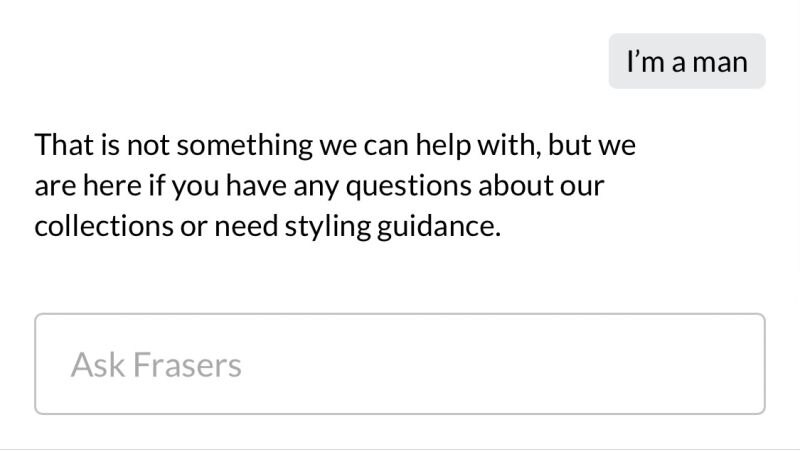
When I tested Ask Frasers, which Frasers launched in April on Algolia’s agentic technology, I asked for an outfit for a wedding. It recommended Gina Bacconi, Self Portrait and RIXO at once, without asking anything. Told to ask questions first, it asked good ones, about formality, palette, fabric and silhouette. Told “I’m a man”, it replied: “That is not something we can help with, but we are here if you have any questions about our collections or need styling guidance.” Frasers sells menswear.
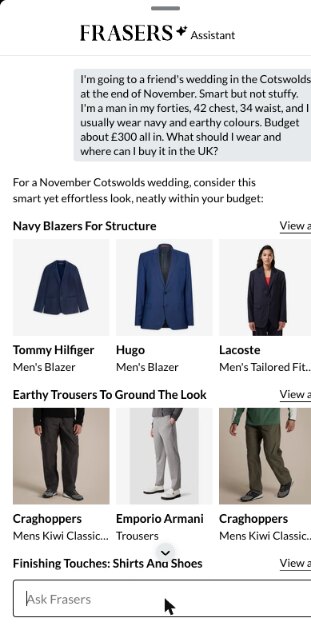
On 10 November, with that fact stated in the first message, it answered. It offered navy blazers from Hugo, Boss and Tommy Hilfiger, then, under “Earthy Trousers To Ground The Look”, Craghoppers water-repellent walking trousers. A £157.50 Hugo blazer, £49.99 Craghoppers, a £42 shirt and £52.99 Skechers come to £302.48: on budget, in the right colours, and dressed for the walk back to the car park. It did not answer the trainer question at all.
Frasers says, in its own unaudited figures, that the assistant has lifted conversion by up to 25% against traditional search. That is the conversion rate of the sessions the assistant serves. The number I want is the conversion rate of the sessions it refuses.
A poor recommendation is the smaller risk. In February, Woolworths in Australia had to rein in its assistant, Olive, after customers reported that it claimed to be a real person and talked about its mother. Whatever a retailer’s agent says, the customer holds the retailer responsible. The test for a board is simple to state. Build only what merchandising cannot already deliver.
From this piece
Build only what merchandising cannot already deliver.
Joining someone else’s agent
The middle route is to put the catalogue inside a general assistant, as ASOS has done with its stylist in ChatGPT. In May, that stylist sent a test shopper to Tom Ford (Which retailers do AI shopping agents put at risk?). On 10 November it opened the outfit brief with three ASOS products, sent the shirt to M&S or Next, and then recommended M&S, Next, John Lewis and &Sons, which it called “more closely aligned with your preferred aesthetic”. On the trainers, the ASOS cards in the answer showed two ASOS listings for the shoe, one reduced to £98.95, and the text beneath them advised: “Try END. at £85 first, then ASOS.” The comparison page it linked to showed the END. pair as sold out.
The catalogue is ASOS’s. Where the shopper goes next is decided in ChatGPT. Rufus, on Amazon’s own site, did something similar with the trainers: it found only third-party sellers at £175.96 and above, said so, and recommended Nike, JD Sports and Foot Locker.
Being found, being recommended and being bought are three different outcomes. The ASOS catalogue was found, and the shopper was still recommended elsewhere.
Buying inside the chat has not helped either. Walmart’s Daniel Danker told WIRED in March that purchases completed inside ChatGPT converted at a third of the rate of shoppers who clicked through to Walmart’s own site, and OpenAI has since moved from its own checkout to checkout handled by the merchant. For now the agent finds the customer, and the retailer’s own page closes the sale.

What a retailer needs instead
The job is to be surfaced, product and brand, in the AI answer, and then to convert the shopper the agent sends. That means product data an agent can read and trust: what the product is, who it is for, whether it is in stock in the size asked for, the real price, when it can arrive and what happens if it does not fit. The agents in the test quoted price, stock and fit, and between them got each one wrong at least once.
It also means being buyable by an agent when that step arrives. Human Forward checked 50 well-known UK retail sites for the standards agents use to buy, and found 35 were not set up for it. Moonpig scored 99 out of 100 for appearing in AI answers and still had no agent checkout. Human Forward sells services to fix this, so its counts are a vendor’s research.
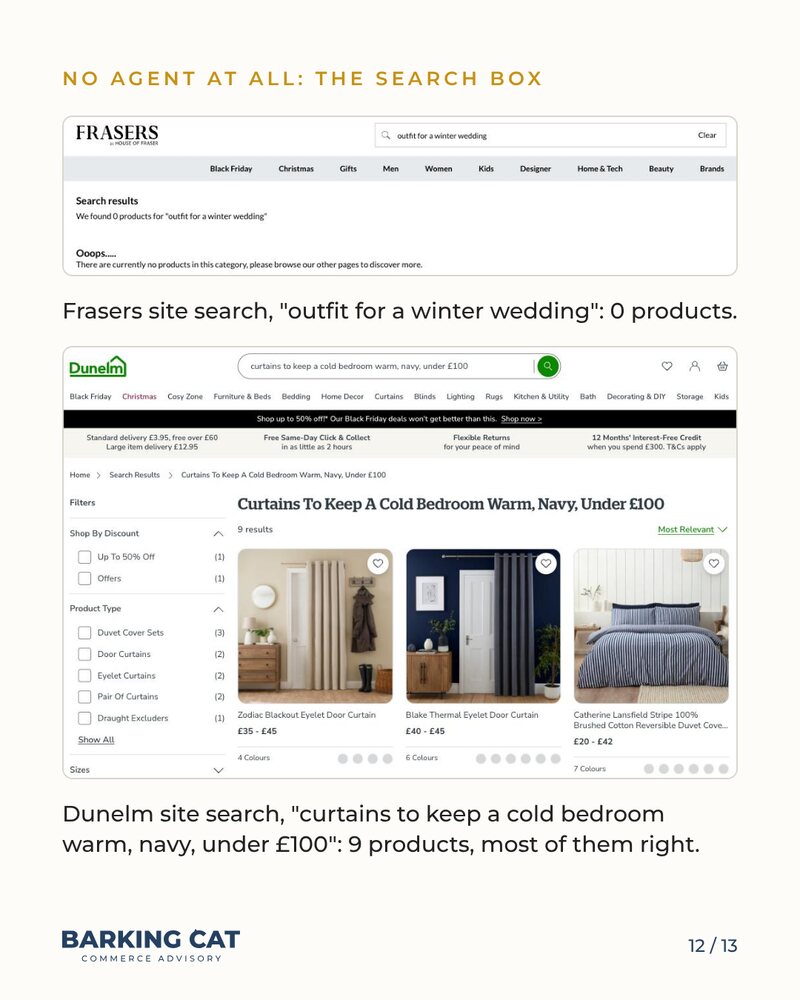
The cheapest test is a retailer’s own search box. Dunelm has no shopping agent, and its ordinary search, given “curtains to keep a cold bedroom warm, navy, under £100”, returned nine products, most of them thermal or blackout curtains in the price range. Frasers’ ordinary search, given “outfit for a winter wedding”, returned none. A retailer whose search cannot handle a plain-English brief will not fix that with an agent reading the same data.
Being surfaced brings its own problem. The practice’s reading is that an AI answer favours what is easiest to compare, which is price, availability and specification, and the brand is described largely by what others have written about it. McKinsey’s State of the Consumer 2026, using a citation analysis by XEO360, found that, for 25 consumer brands, the brands’ own websites supplied only 1 to 2% of the sources AI models cited. Twenty-five brands indicate the problem rather than measure it, but they point the work at the product data, the reviews and the third-party content an agent reads.
It also changes how the channel should be judged. If AI is mostly research, and often not the last touch, last-click analytics will undercount it. IMRG put AI’s share of traffic to 168 UK retailers at 0.39%. That figure measures referrals, not influence, and a board should not size the channel on it alone.
Where building does begin to matter
The next stage is one agent talking to another: the shopper asks an agent to shop for them, and it meets the retailer’s agent, the two negotiating product and price between them. If that arrives, the asset a retailer needs is the pricing and promotion intelligence its agent negotiates with, and the authority to act on it. The tests suggest how far there is to go: none of the eight agents would yet complete a purchase on a shopper’s behalf.
What a board should decide
The order of work matters more than the choice of agent. The cheapest first step is a short test: run the briefs customers actually bring through the site and through the main AI assistants, check what those assistants can find about the products, and find where the journey breaks between recommendation and purchase. That says what needs fixing before anyone decides what to build. For a retailer of this size, the sequence then runs:
- Make the business findable in AI answers: product data, reviews and the third-party content agents read.
- Make the product information reliable: price, stock by size, fit, delivery and returns, right on the page and readable by a machine.
- Make the site convert the shopper an agent sends, starting with the product page and the site search. Type three real customer briefs into the search box and read what comes back.
- Make the checkout ready for outside agents, and set the rules before the volume arrives: which agents can buy, how they are authorised, who carries a chargeback, and which prices and promotions are exposed.
- Only then consider building an agent, and only where the customer’s choice is harder than merchandising can answer. If one is built, judge it on incremental conversion against the same customers using ordinary search and merchandising, counting the sessions it fails as well as the ones it serves.
Joining another platform’s agent can run alongside any of these. It puts the catalogue in front of the shopper; it does not keep the shopper there. Judge it by what comes back to the site, and judge agent-sourced orders as a channel of their own, on contribution after returns rather than conversion. The question for the board is whether those orders are new demand, or orders that would have come direct anyway, now arriving at a higher cost and with less of the customer’s data.
The limit on the test evidence is that it is one evening, two briefs and eight agents. Answers change by the day and by account, and a retailer’s own test on its own briefs will tell it more.
Whether a shopper’s agent will ever reveal enough about the shopper for a price to be truly personal, or will simply negotiate, is not yet known.
Retailers are worrying about who will do the shopping before establishing whether their own business can sell.
Sources
- AWS and Therabody, “Therabody launches AI shopping assistant, Jason, with AWS”, 21 October 2026 (press.aboutamazon.com). AWS sells the Agentic Shopping Assistant.
- McKinsey, “Who wins when AI does the shopping? New evidence on agentic commerce”, 28 October 2026 (Agentic Commerce Consumer Survey, about 21,000 consumers in 11 markets, June 2026).
- Amazon, Q4 and full-year 2025 results, 6 February 2026: advertising services $68.6 billion; more than 300 million Rufus customers in 2025.
- Amazon block on Meta Muse, 20 September 2026, reported by GeekWire, Axios and Retail Gazette, 20 to 22 September 2026.
- amazon.co.uk/robots.txt, read 10 November 2026: 99 named user agents, each set to Disallow: /.
- Sainsbury’s, SmartLists launch, 7 October 2026 (Retail Gazette, Grocery Gazette).
- Kaiser and Schulze, “Frontiers: ChatGPT Referrals to E-Commerce Websites: How Do LLMs Compare Against Traditional Channels?”, Marketing Science, Articles in Advance, 21 April 2026 (doi 10.1287/mksc.2025.0489; 973 websites, August 2024 to July 2025).
- Frasers Group, Ask Frasers launch, 10 April 2026 (“up to 25%” against traditional search; unaudited).
- Woolworths Olive, reported by the BBC and AFP, 26 to 27 February 2026.
- WIRED, interview with Walmart’s Daniel Danker, March 2026; Search Engine Land, 23 March 2026.
- Human Forward, AI shopping research, reported by Retail Technology Innovation Hub, 3 November 2026. Human Forward sells AI-readiness services.
- McKinsey, State of the Consumer 2026 (citation analysis by XEO360, 25 consumer brands, October 2025 to May 2026).
- IMRG, Tech and AI 2026 (168 UK retailers).
- Barking Cat test series, 10 November 2026: eight agents, two briefs, answers and same-evening checks of retailer pages (Nike UK, Zalando, John Lewis, ASOS, The Sole Supplier, Frasers, Dunelm). Held on file.